

Japan’s volatility reflects Bank of Japan’s (BOJ) policy normalisation, not fiscal stress. Fundamentals remain solid, with strong external assets, contained deficits, and continued fiscal discipline. Market moves are being driven by technical flows as Japan exits yield suppression. In this environment, we believe the yen is positioned for appreciation as stretched shorts unwind, and long-dated Japan Government Bonds (JGBs) offer attractive entry points for income and duration exposure.
A story of policy normalisation, not a fiscal crisis.
Japan is rarely a market driven by political noise. For decades, it has been associated with stability — steady institutions, predictable policymaking, and muted political volatility. That’s why recent market reactions to remarks by Prime Minister Sanae Takaichi have felt so unusual. Her campaign‑styled comments on fiscal policy have repeatedly moved the yen and triggered swings in long‑dated Japanese government bonds (JGBs), prompting headlines that question Japan’s fiscal health.
These concerns, often centered on Japan’s high debt‑to‑Gross Domestic Products (GDP) ratio, tell only part of the story. When placed in the broader context of Japan’s macro fundamentals and structural strengths, the picture looks far more balanced. In our view, Japan’s underlying position remains sound.
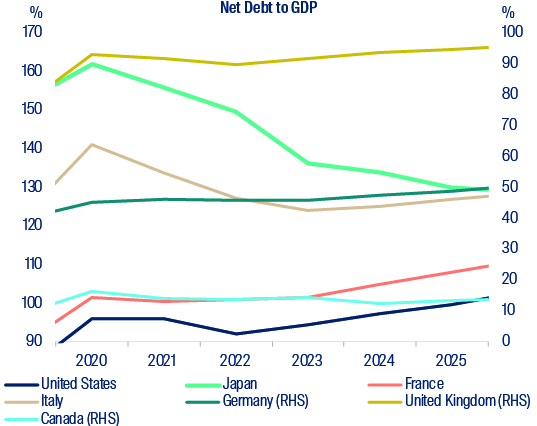
Figure 1
Source: IMF, Bloomberg, as of Dec 2025.
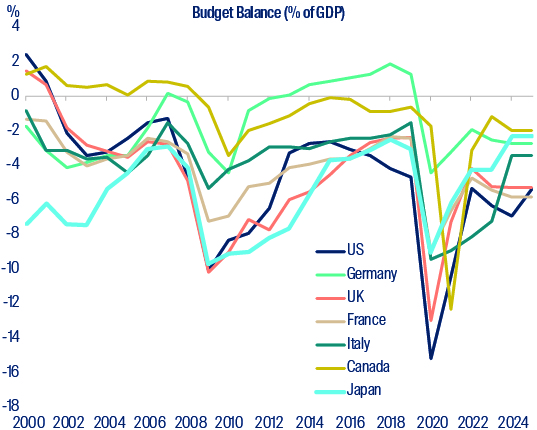
Figure 2
Notes: Based on latest yearly data, only 2025 data was available for the US. Source: Bloomberg Dec 2025.
Japan is one of the world’s largest net international investors
The income it earns from overseas assets has grown into a powerful buffer for its economy. A key point often overlooked is how Japan’s net debt position has improved in recent years, particularly when compared with other major developed economies (Figure 1). While gross debt numbers appear large, Japan has accumulated substantial foreign assets whose returns have outpaced what the government pays on its long‑standing, low‑interest domestic debt.
Fiscal deficits are manageable and improving
Japan does run a primary deficit, but the numbers remain contained. Current projections put Japan’s primary deficit at 2–3% of GDP from FY2026 to FY2028, with a gradual improvement thereafter. Viewed against the G7 nations1, these figures are not alarming — in fact, they compare relatively well (Figure 2). Japan’s fiscal path is challenging but far from unstable, and the government has continued to signal that fiscal discipline remains a priority. The G7 (Group of 7) is an intergovernmental forum consisting of Canada, France, Germany, Italy, Japan, the United Kingdom, and the United States, along with the European Union as a non-enumerated member.
New leadership doesn’t mean fiscal irresponsibility
Regardless who won Japan’s snap election, new fiscal measures were expected. Discussions around consumption tax cuts and targeted stimulus have been ongoing across parties. We see Japan’s Liberal Democratic Party’s (LDP) supermajority as a sign that these measures can be implemented more smoothly. Much of Takaichi’s remarks relate to targeted and temporary stimulus, and come with explicit commitments to maintain fiscal discipline.
Technical factors, not fiscal fears, are driving JGB volatility.
Overseas investors represent a relatively small share of super‑long JGB holdings, yet account for a large share of trading volume. This asymmetry amplifies price moves during a time when the BOJ is tapering off its purchases of long-tenured JGBs. Markets have been long accustomed to the BOJ being the largest buyer of Japanese government bonds, but it is important to remember that this should not be and will not be the market norm going forward. The Bank of Japan has been tapering its purchases, stepping back from nearly two decades of yield curve control. This marks the end of an era where the BOJ effectively suppressed long-term yields. As such, volatility is inevitable as the market adjusts to a more dynamic equilibrium through price discovery.
JGB yields and the yen have deviated from long term averages. 10 Year JGBs are now trading above 2%, while the JPY is cheap compared to its 5 or 10 year averages of 138 and 124 respectively. We believe there resides attractive opportunities to hold the JPY and JGBs for various reasons:
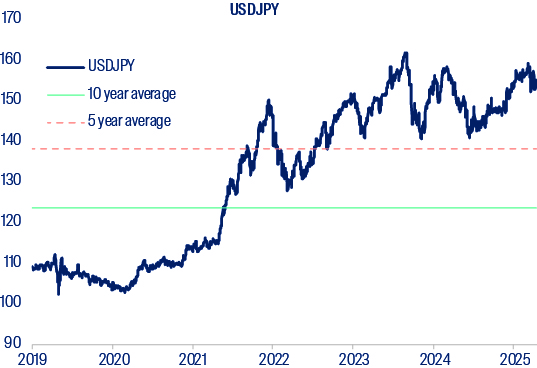
Figure 3
Source: Bloomberg, as of 20 January 2026.
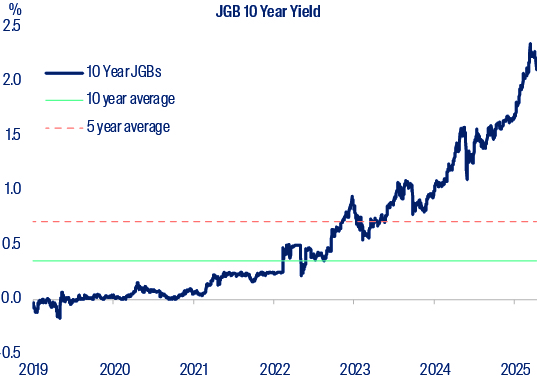
Figure 4
Bloomberg, as of 20 January 2026.
JPY:
- Policymakers monitor yen weakness closely due to its impact on domestic inflation. Previous episodes have shown that authorities are willing to intervene to support the yen to avoid excessive depreciation.
- Carry trade positioning looks stretched: hedge funds remain short yen, while real money flows have turned neutral to long over the past year — suggesting potential for a reversal.
- In any global risk off environment (eg: Middle east geopolitics), the yen is likely to benefit from safe haven demand.
JGBs:
- Higher yields offer compelling income opportunities for income‑oriented strategies.
- Long‑dated JGBs are becoming a useful instrument for expressing duration views as price discovery improves.
- With fiscal expectations stabilising and deficit projections contained, we believe the long end of the curve appears more balanced and attractive for income-oriented investors.
Japan’s recent market turbulence says less about fiscal fragility and more about a market adjusting to life without guaranteed BOJ liquidity. After decades of ultra‑cheap yen funding and suppressed yields, global investors need to recalibrate to a new reality: Japan is no longer the world’s anchor of zero‑cost capital.
Source: First Sentier Investors as of 20 February 2026
1 The G7 (Group of 7) is an intergovernmental forum consisting of Canada, France, Germany, Italy, Japan, the United Kingdom, and the United States, along with the European Union as a non-enumerated member.
Read our latest insights
Important information
The information contained within this material is generic in nature and does not contain or constitute investment or investment product advice. The information has been obtained from sources that First Sentier Group believes to be reliable and accurate at the time of issue but no representation or warranty, expressed or implied, is made as to the fairness, accuracy, completeness or correctness of the information. To the extent permitted by law, neither First Sentier Group, nor any of its associates, nor any director, officer or employee accepts any liability whatsoever for any loss arising directly or indirectly from any use of this material. The information herein is for information purposes only; it does not constitute investment advice and/or recommendation, and should not be used as the basis of any investment decision. Some of the funds mentioned herein are not authorised for offer/sale to the public in certain jurisdiction.
The value of investments and the income from them may go down as well as up and you may not get back your original investment. Past performance is not necessarily a guide to future performance. Please refer to the offering documents for details, including the risk factors. Reference to specific securities (if any) is included for the purpose of illustration only and should not be construed as a recommendation to buy or sell the same. All securities mentioned herein may or may not form part of the holdings of First Sentier Group’s portfolios at a certain point in time, and the holdings may change over time.
This material has been prepared for general information purpose. It does not purport to be comprehensive or to render special advice. The views expressed herein are the views of the writer at the time of issue and not necessarily views of First Sentier Group. Such views may change over time. This is not an offer document, and does not constitute an investment recommendation. No person should rely on the content and/or act on the basis of any matter contained in this material without obtaining specific professional advice. The information in this material may not be reproduced in whole or in part or circulated without the prior consent of First Sentier Group. This material shall only be used and/or received in accordance with the applicable laws in the relevant jurisdiction.
In Hong Kong, this material is issued by First Sentier Investors (Hong Kong) Limited and has not been reviewed by the Securities & Futures Commission in Hong Kong. In Singapore, this material is issued by First Sentier Investors (Singapore) whose company registration number is 196900420D. This advertisement or material has not been reviewed by the Monetary Authority of Singapore. First Sentier Group, First Sentier Investors, FSSA Investment Managers, Stewart Investors, RQI Investors and Igneo Infrastructure Partners are the business names of First Sentier Investors (Hong Kong) Limited. First Sentier Group (registration number 53507290B), First Sentier Investors (registration number 53236800B), FSSA Investment Managers (registration number 53314080C), Stewart Investors (registration number 53310114W), RQI Investors (registration number 53472532E) and Igneo Infrastructure Partners (registration number 53447928J) are the business names of First Sentier Investors (Singapore).
First Sentier Investors (Hong Kong) Limited and First Sentier Investors (Singapore) are part of the investment management business of First Sentier Group, which is ultimately owned by Mitsubishi UFJ Financial Group, Inc. (“MUFG”), a global financial group. First Sentier Group includes a number of entities in different jurisdictions.
To the extent permitted by law, MUFG and its subsidiaries are not responsible for any statement or information contained in this material. Neither MUFG nor any of its subsidiaries guarantee the performance of any investment or entity referred to in this material or the repayment of capital. Any investments referred to are not deposits or other liabilities of MUFG or its subsidiaries, and are subject to investment risk, including loss of income and capital invested.
© First Sentier Group
 |  |
|---|